Enter a MAC address (or a prefix of it, such as the first three bytes — the OUI) to look up the vendor that IEEE has registered it to.
| Address type | ||
|---|---|---|
| Registry | ||
| Identifier | ||
| Vendor |
About OUIs
A MAC address is 6 bytes (48 bits) long. For an address assigned by the IEEE, the first 3 bytes are the OUI (Organizationally Unique Identifier), a vendor identifier, and the remaining 3 bytes are assigned by that vendor to uniquely identify each device. IEEE assigns and manages OUIs per vendor, so the first 3 bytes of a MAC address can be used to infer the device’s vendor.
02:xx:xx:xx:xx:xx, or more generally x2/x6/xA/xE) is 1 is a locally administered address, set by the device itself and unrelated to any IEEE assignment. MAC addresses on virtual machines and randomized Wi-Fi MAC addresses fall into this category. No IEEE registration exists for them, so the vendor cannot be identified. This tool examines the first octet of the input, determines the U/L and I/G bits, and shows the result in the “Address type” row; for a locally administered address it tells you so regardless of the vendor lookup result (for a multicast address, it looks up the OUI assignee with the I/G bit cleared back to 0).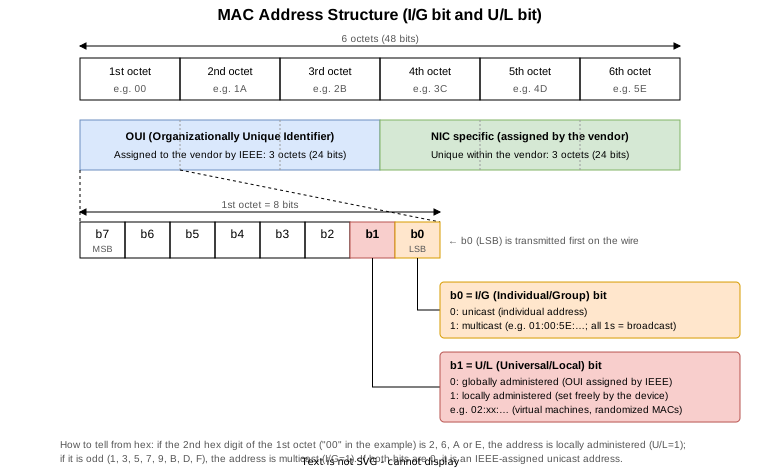
IEEE splits its assignments into three registries by block size:
| Registry | Block size | Overview |
|---|---|---|
| MA-L | 24 bits (first 3 bytes) | The classic “OUI” — the most common assignment |
| MA-M | 28 bits (first 3.5 bytes) | For smaller vendors than MA-L |
| MA-S | 36 bits (first 4.5 bytes) | For smaller vendors than MA-M |
MA-M and MA-S assignments are carved out of MA-L blocks that IEEE itself holds for finer-grained allocation. So looking up only the first 3 bytes of a MAC address assigned under MA-M or MA-S returns “IEEE Registration Authority” rather than the actual vendor — enter at least 7 hex digits for MA-M, or 9 for MA-S, to identify the vendor.
This tool periodically fetches and caches IEEE’s public MA-L registry (oui.csv), MA-M registry (mam.csv), and MA-S registry (oui36.csv) on the API server and searches them. Input can be colon-separated (00:1A:2B:3C:4D:5E), hyphen-separated (00-1A-2B-3C-4D-5E), Cisco-style dot notation (001A.2B3C.4D5E), or unseparated (001A2B3C4D5E); besides a full MAC address, you can also search using just the first 3 bytes (MA-L/OUI) or a longer MA-M/MA-S assignment prefix.